
U.S. time zones by state
The 50 states span 6 standard time zones: Eastern, Central, Mountain, Pacific, Alaska, and Hawaii-Aleutian. Of these states, 36 lie entirely in one zone and 14 are split between two. All states except Arizona and Hawaii observe daylight saving time. The zone boundaries are set by the U.S. Department of Transportation in 49 CFR Part 71.
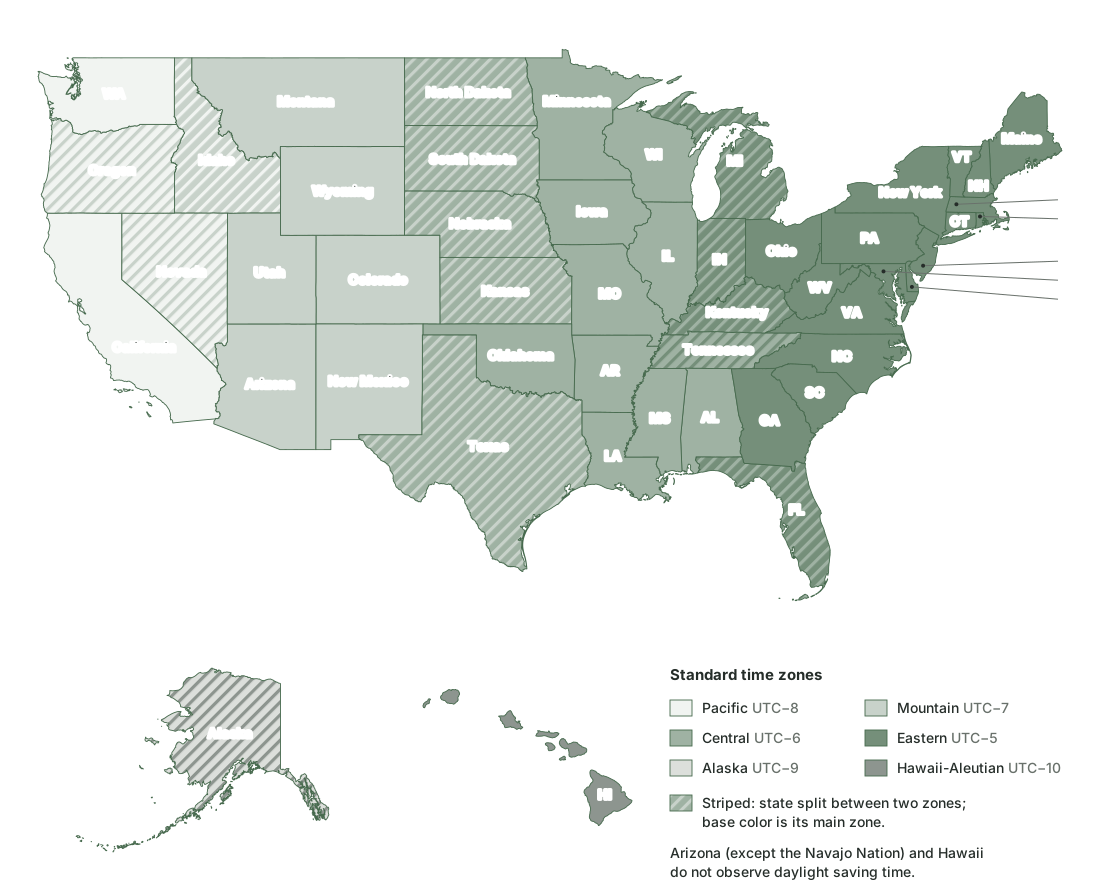
The six time zones
When it is noon Eastern Standard Time, it is 11 a.m. Central Standard Time, 10 a.m. Mountain Standard Time, 9 a.m. Pacific Standard Time, 8 a.m. Alaska Standard Time, and 7 a.m. Hawaii-Aleutian Standard Time. Daylight saving time moves each zone one hour ahead, so the same gaps hold through the summer, except for Arizona and Hawaii, which stay on standard time.
| Zone | Standard | Daylight | Entirely in zone | Partly in zone |
|---|---|---|---|---|
| Eastern | UTC−5 | UTC−4 | 17: CT, DE, GA, ME, MD, MA, NH, NJ, NY, NC, OH, PA, RI, SC, VT, VA, WV | FL, IN, KY, MI, TN |
| Central | UTC−6 | UTC−5 | 10: AL, AR, IL, IA, LA, MN, MS, MO, OK, WI | FL, IN, KS, KY, MI, NE, ND, SD, TN, TX |
| Mountain | UTC−7 | UTC−6 | 6: AZ, CO, MT, NM, UT, WY | ID, KS, NE, NV, ND, OR, SD, TX |
| Pacific | UTC−8 | UTC−7 | 2: CA, WA | ID, NV, OR |
| Alaska | UTC−9 | UTC−8 | None | AK |
| Hawaii-Aleutian | UTC−10 | UTC−9 | 1: HI | AK |
Time zone of each state
| State | Time zone | Daylight saving time |
|---|---|---|
| Alabama | Central | Yes |
| Alaska | Alaska and Hawaii-Aleutian | Yes |
| Arizona | Mountain | No (Navajo Nation: yes) |
| Arkansas | Central | Yes |
| California | Pacific | Yes |
| Colorado | Mountain | Yes |
| Connecticut | Eastern | Yes |
| Delaware | Eastern | Yes |
| District of Columbia | Eastern | Yes |
| Florida | Eastern and Central | Yes |
| Georgia | Eastern | Yes |
| Hawaii | Hawaii-Aleutian | No |
| Idaho | Mountain and Pacific | Yes |
| Illinois | Central | Yes |
| Indiana | Eastern and Central | Yes |
| Iowa | Central | Yes |
| Kansas | Central and Mountain | Yes |
| Kentucky | Eastern and Central | Yes |
| Louisiana | Central | Yes |
| Maine | Eastern | Yes |
| Maryland | Eastern | Yes |
| Massachusetts | Eastern | Yes |
| Michigan | Eastern and Central | Yes |
| Minnesota | Central | Yes |
| Mississippi | Central | Yes |
| Missouri | Central | Yes |
| Montana | Mountain | Yes |
| Nebraska | Central and Mountain | Yes |
| Nevada | Pacific and Mountain | Yes |
| New Hampshire | Eastern | Yes |
| New Jersey | Eastern | Yes |
| New Mexico | Mountain | Yes |
| New York | Eastern | Yes |
| North Carolina | Eastern | Yes |
| North Dakota | Central and Mountain | Yes |
| Ohio | Eastern | Yes |
| Oklahoma | Central | Yes |
| Oregon | Pacific and Mountain | Yes |
| Pennsylvania | Eastern | Yes |
| Rhode Island | Eastern | Yes |
| South Carolina | Eastern | Yes |
| South Dakota | Central and Mountain | Yes |
| Tennessee | Central and Eastern | Yes |
| Texas | Central and Mountain | Yes |
| Utah | Mountain | Yes |
| Vermont | Eastern | Yes |
| Virginia | Eastern | Yes |
| Washington | Pacific | Yes |
| West Virginia | Eastern | Yes |
| Wisconsin | Central | Yes |
| Wyoming | Mountain | Yes |
Split states and local exceptions
The lines inside these states follow county boundaries in most places, and rivers, highways, or a meridian in a few. The descriptions summarize 49 CFR Part 71 and local practice where a community keeps a different time unofficially.
Alabama. All of Alabama is legally in Central Time, but Phenix City and nearby communities along the Georgia line, including Lanett and Valley, unofficially keep Eastern Time.
Alaska. The Aleutian Islands west of 169 degrees 30 minutes west longitude are in the Hawaii-Aleutian zone, and the rest of the state is in the Alaska zone.
Florida. The Panhandle west of the Apalachicola River is on Central Time, except the part of Gulf County south of the Jackson River and Intracoastal Waterway, which shares Eastern Time with the rest of Florida.
Idaho. North of the line formed by the Idaho County-Lemhi County boundary and the main channel of the Salmon River, Idaho is in the Pacific zone; the rest of the state is Mountain.
Indiana. Jasper, Lake, LaPorte, Newton, Porter and Starke counties in the northwest and Gibson, Perry, Posey, Spencer, Vanderburgh and Warrick counties in the southwest are in the Central zone; the rest of the state is in the Eastern zone.
Kansas. Greeley, Hamilton, Sherman and Wallace counties along the Colorado line are in the Mountain zone; the rest of the state is in the Central zone.
Kentucky. Central Time applies west and south of Meade, Hardin, LaRue, Taylor, Casey, Pulaski and Wayne counties, including Bowling Green, Owensboro and Paducah; the rest of Kentucky, including Louisville and Lexington, is on Eastern Time.
Michigan. Gogebic, Iron, Dickinson and Menominee counties, along the Wisconsin line in the Upper Peninsula, are in the Central zone; the rest of the state is in the Eastern zone.
Nebraska. The Panhandle, Arthur, Chase, Dundy, Grant, Hooker, Keith and Perkins counties and the western part of Cherry County are in the Mountain zone; the rest of the state is in the Central zone.
Nevada. West Wendover is legally in the Mountain zone, and Jackpot and a few other communities near the Idaho line unofficially keep Mountain time, while the rest of Nevada is Pacific.
North Dakota. Adams, Billings, Bowman, Golden Valley, Grant, Hettinger, Slope and Stark counties, parts of Dunn and McKenzie counties and Sioux County west of State Highway 31 are in the Mountain zone; the rest of the state is in the Central zone.
Oklahoma. All of Oklahoma is legally in Central Time, but Kenton, in the far northwest corner of the Panhandle, informally keeps Mountain Time.
Oregon. Malheur County north of the southern line of Township 35 South is in the Mountain zone, and the rest of Oregon is Pacific.
South Dakota. The area west of the Missouri River above Pierre and west of the western lines of Jones, Mellette and Todd counties farther south is in the Mountain zone; the rest of the state is in the Central zone.
Tennessee. Eastern Time applies from Scott, Morgan, Roane, Rhea and Hamilton counties eastward, including Knoxville and Chattanooga; the rest of Tennessee, including Nashville and Memphis, is on Central Time.
Texas. El Paso and Hudspeth counties in far western Texas are on Mountain Time; the rest of the state is on Central Time.
Arizona, Hawaii, and daylight saving time
Daylight saving time runs from 2 a.m. on the second Sunday in March to 2 a.m. on the first Sunday in November. Federal law lets a state stay on standard time all year but not adopt daylight time permanently. Arizona has stayed on Mountain Standard Time since 1968, so from March to November its clocks match Pacific Daylight Time in California and Nevada. The Navajo Nation, which extends into Arizona, New Mexico, and Utah, observes daylight saving time throughout; the Hopi Reservation, which it surrounds, does not. Hawaii also stays on standard time, as do Puerto Rico, the U.S. Virgin Islands, Guam, the Northern Mariana Islands, and American Samoa. The Aleutian Islands share the Hawaii-Aleutian zone with Hawaii but do observe daylight saving time, so in summer they are an hour ahead of Honolulu.
Indiana’s time zone history
For decades before 2006, most of Indiana stayed on Eastern Standard Time all year, while the counties near Chicago and Evansville kept Central Time with daylight saving time. Indiana adopted daylight saving time statewide in April 2006. That year eight counties moved from Eastern to Central Time; six of them returned to Eastern in 2007. Today 12 counties, six in the northwest and six in the southwest, are on Central Time, and the rest of the state is on Eastern Time.
Who sets the time zones
The U.S. Department of Transportation oversees time zones under the Standard Time Act of 1918 and the Uniform Time Act of 1966. A boundary moves only through a DOT rulemaking, usually at the request of local officials, judged mainly on the convenience of commerce. The current boundaries are in 49 CFR Part 71; the DOT explains how to request a change. The map uses the Census Bureau’s 2025 state boundaries.
Frequently asked questions
How many time zones does the United States have?
The 50 states use 6 standard time zones: Eastern, Central, Mountain, Pacific, Alaska, and Hawaii-Aleutian. Counting the territories, U.S. law sets nine, adding Atlantic (Puerto Rico and the U.S. Virgin Islands), Samoa, and Chamorro (Guam and the Northern Mariana Islands).
Which states are in two time zones?
There are 14: Alaska, Florida, Idaho, Indiana, Kansas, Kentucky, Michigan, Nebraska, Nevada, North Dakota, Oregon, South Dakota, Tennessee, and Texas. No state is in more than two.
Does Arizona observe daylight saving time?
No. Arizona stays on Mountain Standard Time all year, so in summer its clocks match California’s. The exception is the Navajo Nation in northeastern Arizona, which observes daylight saving time; the Hopi Reservation, surrounded by the Navajo Nation, does not.
What time zone is Texas in?
Most of Texas is on Central Time. El Paso and Hudspeth counties in far western Texas are on Mountain Time.
When does daylight saving time start and end?
It begins at 2 a.m. local time on the second Sunday in March and ends at 2 a.m. on the first Sunday in November, the schedule in effect since 2007.